
Ethereum: A Comprehensive Overview of Different Cryptocurrencies and Their Unique Value-Added Features
The world of cryptocurrency has exploded in recent years, with hundreds of innovative currencies competing for attention. Among them, Ethereum stands out as one of the pioneers and major players in the space. With its unique value-added, innovative implementations, and diverse use cases, Ethereum is a fascinating subject to explore. In this article, we will delve into the differences between different cryptocurrencies and highlight their innovations, highlighting a catalog that makes Ethereum stand out.
What are cryptocurrencies?
Before we delve into the specific differences, it is important to understand what cryptocurrencies are. A cryptocurrency is a digital or virtual currency that uses cryptography for security purposes and is decentralized, meaning that it is not controlled by any government or financial institution. Transactions are recorded on a public ledger called a blockchain.
Ethereum: The Oldest Major Currency
Ethereum (ETH) was launched in 2015 as the second largest cryptocurrency after Bitcoin. It was originally known as Ethereum Classic (ETC), but in 2016 it underwent a hard fork, resulting in the creation of Ethereum (ETH). Today, ETH is one of the largest and most widely recognized cryptocurrencies.
Differences between Ethereums
- Smart Contracts: Ethereum’s smart contract functionality allows the creation and execution of self-executing contracts with the ability to automate various processes. This feature has revolutionized industries such as finance, gaming, and supply chain management.
- Decentralization: Ethereum is a decentralized platform, meaning there is no single point of control or ownership. The network is maintained by a community of developers and miners, who drive its growth.
- Gas Fees: Ethereum gas fees are used to incentivize transactions on the blockchain. Lower gas fees make it more affordable for users, especially in low-income countries.
- Smart Wallets: Ethereum offers a range of smart wallets that allow users to securely store, send, and receive ETH.
Other Major Cryptocurrencies
- Bitcoin (BTC)
- Litecoin (LTC)
- Monero (XMR)
- Dash (DASH)
Unique Value Added: What Makes Each Cryptocurrency Different?
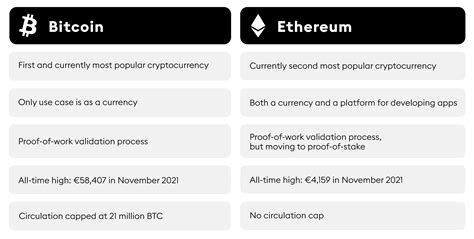
While all cryptocurrencies have their own unique value added, some stand out for their innovative implementations:
- Bitcoin (BTC):
- The first cryptocurrency
- Limited supply of 21 million coins
- Decentralized and open-source blockchain
- Litecoin (LTC)
- Fast transaction processing speed
- Lower gas fees compared to Bitcoin
- Designed as a peer-to-peer cryptocurrency with minimal central authority
- Monero (XMR)
- Private key-based transactions for secure anonymity
- Limited supply of 63 million coins
- Advanced cryptography for secure and untraceable transactions
- Dash (DASH)
- Fast and secure payment processing
- Multi-way transaction mechanism for faster and more private transactions
- Decentralized network without a central authority
Innovative implementations
- Stellar (XLM): A decentralized open-source blockchain platform that enables fast and cheap cross-border payments.
- EOS: A decentralized operating system that offers a range of applications for scalability, security, and user experience.
- Cardano (ADA): A proof-of-stake (PoS) blockchain that focuses on scalability, sustainability, and community engagement.
Conclusion
Ethereum is not just another cryptocurrency; It is an innovative platform with unique added value in smart contracts, decentralization and gas fees. With its innovative implementation, diverse use cases and widespread adoption, Ethereum has solidified its position as one of the most significant players in the cryptocurrency world.